

Background
The corporate sustainability agenda has reached a critical turning point, framed by intense investor and regulatory momentum alongside international agreements on issues like biodiversity and human rights. While the drive toward climate action is clear, leading companies now increasingly recognize that the path to a green transition is incomplete if it is not also a just and fair transition that leaves no-one behind.
This requires businesses to look beyond environmental strategies and answer a fundamental question: How do our sustainability actions create positive, equitable outcomes for all, especially those most vulnerable to change?
This is where the social dimension of sustainability becomes a strategic issue for businesses. A company’s approach to including disadvantaged groups in corporate sustainability strategies – including the 1.3 billion persons with disabilities in the world - serves as a powerful litmus test for the credibility and robustness of its entire strategy. If efforts towards a green economy are not inclusive, if evolving technologies create new barriers for more vulnerable groups, or if stakeholder engagement does not include the perspective of disadvantaged communities, then this transition is not truly "just."
As we mark two decades since the UN Convention on the Rights of Persons with Disabilities ratified by more than 190 states worldwide, the corporate conversation is shifting from compliance to strategic inclusion. Leading into London Climate Action Week and building on a decade of collaboration between GRI and Fundacion ONCE through Disability Hub Europe, this session will bring together experts from the corporate world, international organizations, and standards bodies to explore:
- How to build a compelling case for integrating social goals into business’ sustainability strategies, together with climate and nature.
- How leading companies are beginning to translate their social, inclusion, and disability initiatives into tangible value for employees, regulators and investors, as part of a truly integrated corporate sustainability strategy.
- How sustainability reporting helps promote an integrated vision of sustainability from both an environmental and a social perspective.
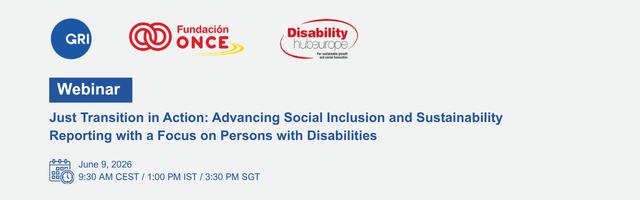
Date & Time
Jun 9, 2026 9:30 - 10:30AM CET
Register here to secure your spot: Webinar Registration - Zoom
Practical information
The webinar will be hosted by GRI, in English. International Sign Language Interpretation and captioning will be provided.
About the Organizers
Global Reporting Initiative (GRI): GRI is the independent, international organization that provides the global common language for organizations to report on their impacts. The GRI Standards, the world’s most widely used for sustainability reporting, are developed through a multi-stakeholder process and enable organizations to be transparent about their effects on the economy, environment, and people. GRI's system of standards provides a comprehensive framework to report on environmental and social dimensions. This includes GRI 101: Biodiversity 2024, which aligns with the Kunming-Montreal Global Biodiversity Framework, and the GRI 102: Climate Change 2025, which features a dedicated disclosure on a just transition. For the social dimension, a major revision of 11 GRI Topic Standards on Labor is currently underway between June 2026 - June 2027, covering key themes of employment practices, career development, and workers' rights to further strengthen social reporting.
Disability Hub Europe (D-Hub): Disability Hub Europe is a multi-stakeholder initiative. It was designed to be a cross-cutting, innovative project for the development of the "Disability & Sustainability" binomial in Europe and beyond. Its objective is to serve as a reference platform for analysis, generation of knowledge, exchange of good practices, and innovation in the field of disability and sustainability. Among its partners, D-Hub includes GRI.
*Fundacion ONCE: Fundación ONCE’s core mission is the social inclusion of persons with disabilities, with a special focus in the areas of training, employment and universal accessibility of products, services and environments. The Foundation was created in 1988 by the ONCE (the Spanish National Organization for the Blind) as the primary instrument of cooperation and solidarity with persons with all types of disabilities.