

9 June 2026
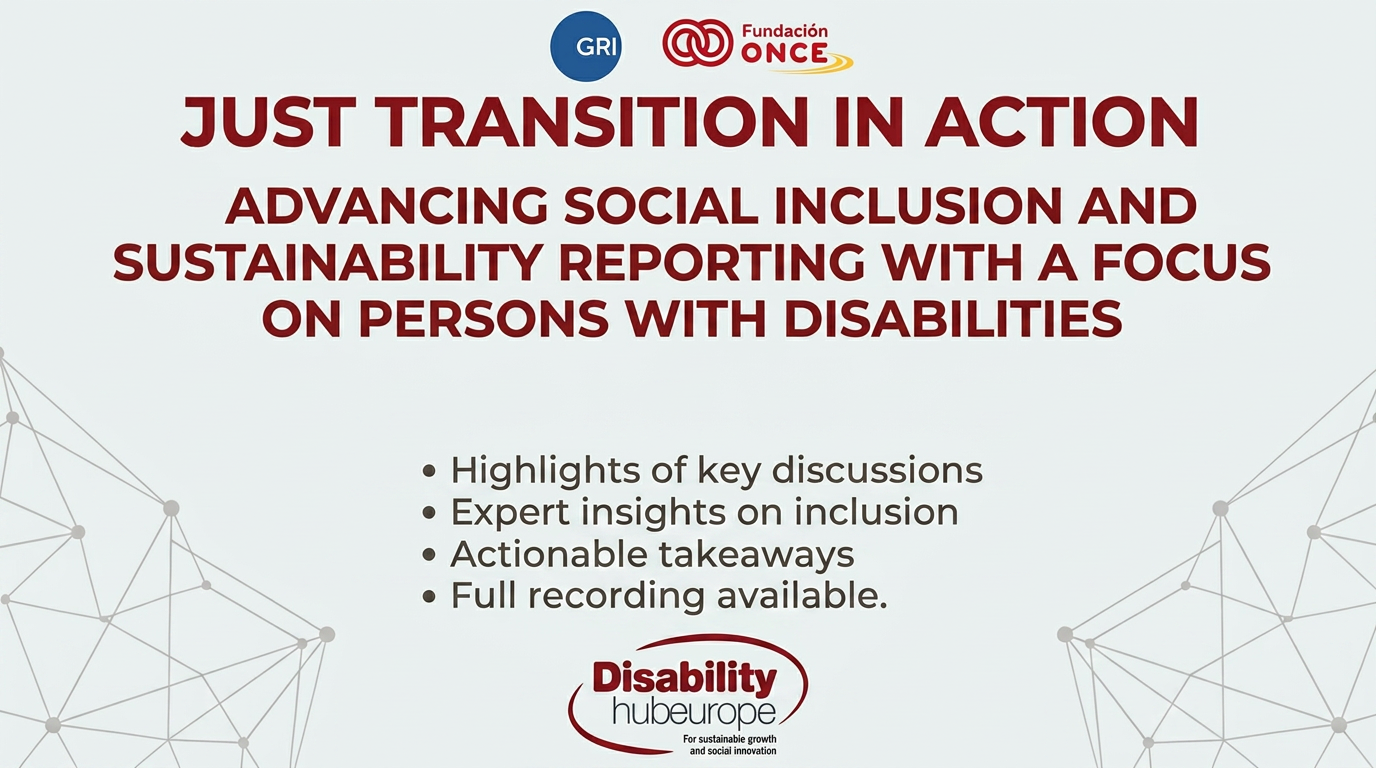
On 9 June 2026, Disability Hub Europe (D-Hub), Fundación ONCE, and the Global Reporting Initiative (GRI) jointly organized the webinar, "Just Transition in Action: Advancing Social Inclusion and Sustainability Reporting".
- The discussion revealed three core principles for any organization seeking to build a truly inclusive Just Transition strategy:
- Integrate a 360-Degree Approach: The transition to a sustainable economy must structurally integrate disability inclusion into emerging environmental strategies. This means viewing persons with disabilities not just as employees, but as consumers, community members, and suppliers across the entire value chain.
- Accountability Requires Context: True corporate sustainability moves beyond simple data points. It requires transparently reporting the strategic context, policies, and management-level targets that are driving progress on equal opportunities.
- Bridge Gaps Through Standardized Tools: Real progress relies on bridging the operational divide between ESG teams and disability practitioners by using clear, practical frameworks (like the ILO’s Self-Assessment Tool and robust reporting standards).
- Moving from basic compliance to strategic advantage requires robust data methodologies, transparent reporting frameworks, and operational shifts that engage the entire corporate value chain.
- By leveraging transparent sustainability reporting, companies can make genuine workplace inclusion integral to their long-term success.
The Strategic Intersection of Sustainability and Inclusion
Coinciding with London Climate Action Week and the 20th anniversary of the UN Convention on the Rights of Persons with Disabilities, the event explored the shift from compliance-driven reporting to strategic, value-driven inclusion. The discussion brought together leaders from business, standard-setting bodies, and global networks to share operational insights.
The corporate sustainability agenda has reached a turning point, driven by investor pressure, regulation, and global agreements on climate, biodiversity, and human rights. In this context, companies increasingly recognize that the green transition must also be a just one, ensuring no one is left behind. This requires integrating a solid social dimension into sustainability strategies and addressing how actions create equitable outcomes for vulnerable groups, including the more than 1.3 billion persons with disabilities worldwide. The focus is shifting from compliance to strategic inclusion.
Operationalizing the Just Transition
Opening the session, Harold Pauwels, Director of Standards at GRI, and Susanne Stormer, Chair of the Global Sustainability Standards Board (GRI), outlined why a truly ‘just’ transition must prioritize people. Stormer emphasized that corporate accountability relies on transparent sustainability reporting, noting that "visibility is the foundation for accountability" and asserting that a business strategy overlooking inclusion cannot be considered truly sustainable. She also highlighted upcoming revisions to GRI labour-related standards, designed to translate international principles into practical reporting.
Moderated by Carla Bonino (ONCE Foundation) and Harold Pauwels (GRI), an expert panel featuring Jürgen Menze (ILO Global Business and Disability Network - GBDN), Gemma Sanchez (EFRAG), and Monica Perez Lobo (Toyota Motor Europe) discussed the 'how' and 'why' of embedding inclusion into sustainability frameworks.
Key operational insights included:
- Structuring inclusion across the value chain (Toyota Motor Europe): Monica Perez Lobo emphasized the need to scale inclusion systematically rather than relying on isolated, local initiatives. Operationally, Toyota achieves this by implementing sustainable purchasing guidelines across its complex supply network and utilizing employee self-identification surveys to measure representation while simultaneously gauging and building psychological safety within the workforce.
- Contextualizing data in reporting frameworks (EFRAG): Gemma Sanchez-Danez highlighted how frameworks like the European Sustainability Reporting Standards (ESRS) require strategic context alongside raw data. To demonstrate genuine progress, organizations are warned against relying solely on static metrics, such as a simple headcount of persons with disabilities. Instead, companies are encouraged to utilize entity-specific metrics, such as representation breakdowns in management, to accurately reflect equal opportunity progression.
- Bridging the gap between ESG and disability practitioners (ILO GBDN): Jürgen Menze addressed the operational disconnect that often exists between corporate sustainability teams and disability inclusion experts. By leveraging practical frameworks - such as the ILO’s Self-Assessment Tool and the Business Leaders' Pledge on Disability-Inclusive Sustainability - companies can seamlessly embed disability metrics into broader human rights discussions and ensure fair access to emerging “green jobs” and other upskilling opportunities within the green economy.
Closing the session, Fernando Riaño, Director for Institutional Relations and Sustainability at ONCE Social Group and Chair of the Board of the International Disability Alliance (IDA), noted the 20th anniversary of the UN Convention on the Rights of Persons with Disabilities (UNCRPD). Riaño advocated for a 360-degree approach - viewing persons with disabilities not just as employees, but as consumers, value chain participants, and community members - to maximize positive business impact and overcome traditional corporate silos.
Disability Hub Europe is committed to advancing the social dimension of sustainability. Follow our work for the latest insights on building an inclusive and just transition.
Resources
To support your organization's journey from compliance to strategic inclusion, please explore the tools and frameworks discussed during the session:
- Watch the full webinar recording and download the webinar slides.
- Disability in Sustainability Reporting: Practical joint guidance from Disability Hub Europe and GRI.
- Disability Disclosure Under the CSRD: A Benchmark Analysis: Disability Hub Europe’s publication analyzing how early-adopting companies are applying the ESRS regarding disability disclosure.
- ILO GBDN resources include: ILO GBDN Self-Assessment Tool (a free internal management tool to measure your company's disability inclusion progress); Putting the I in ESG (ILO's technical guidance on viewing disability inclusion as a strategic advantage for corporates and investors) and the ILO GBDN Business Leaders' Pledge on Disability-Inclusive Sustainability (a CEO-level commitment to double materiality and inclusion).